

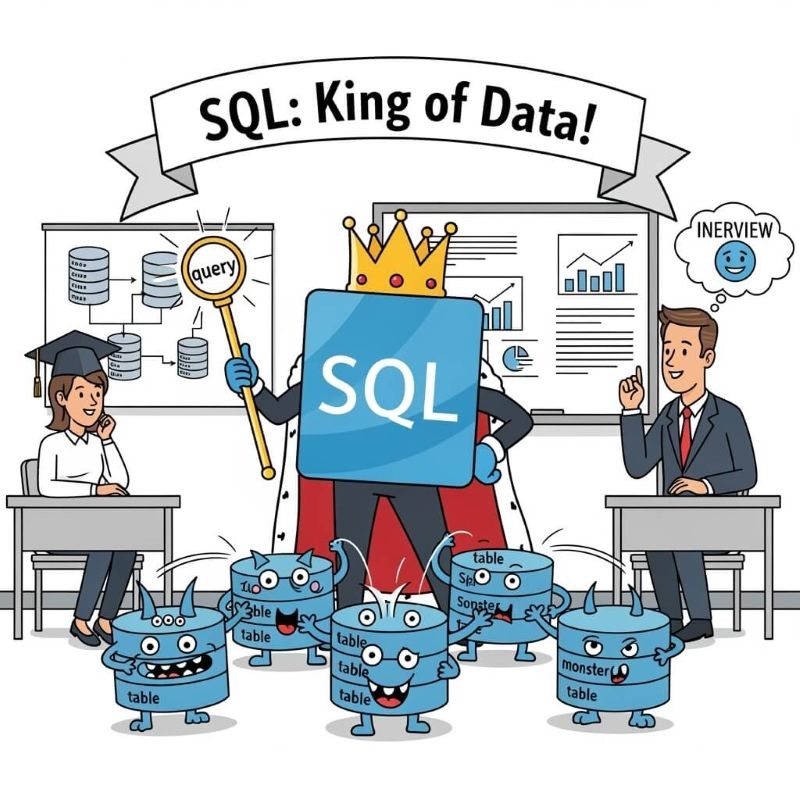
SQL Interview Questions represent a significant component of Technical Hiring in today's workplace. Applicants for data analyst, Back-End Developer, and Database Administrator positions will want to perform well during the SQL interview to advance in their application process and avoid being filtered out. Employers utilize SQL Interview Questions to evaluate an applicant's problem-solving capabilities in real-world situations, query optimization techniques, and a candidate's proficiency in handling data.
This interview tips guide provides extensive coverage of frequently asked SQL interview questions, as well as commonly used SQL interview questions during interviews. It also includes comprehensive questions and answers that promote a candidate's development to think like a trained SQL professional, rather than just memorizing SQL syntax. Are you ready to set out with confidence in your following interview?
Interviewers assess the capabilities of applicants to determine if they can effectively interact with a relational database using SQL interview questions. The primary reason why hiring managers ask SQL interview questions is due to the heavy reliance on SQL as the means for making successful data-driven business decisions. Employers require professionals who can perform the following activities:
Because SQL is such a significant component of what drives a successful business, most SQL interview questions and answers are grounded in real-world experiences and practical applications. SQL interview questions and answers are often where an applicant will find an introduction to the theory of SQL.
Related Resources: Key Interview Soft Skills That Will Land Your Dream Job
Before moving on to more advanced types of SQL questions asked during an interview, most hiring managers typically begin with some foundational questions related to SQL. SQL foundational interview questions focus specifically on the applicant's understanding of SQL, rather than just their experience writing SQL for their previous employer.
As a reminder, SQL is the language used to access and manage relational databases. Every SQL interview will typically have this question to gauge the candidate’s conceptual understanding of SQL.
These definitions will also frequently appear in SQL interview questions asked during SQL interviews, particularly in entry-level and mid-level SQL job postings.
Many Common SQL interview questions emphasize developing queries and determining how well you can extract data efficiently.
The SELECT statement is a method of extracting data from one or more tables. Typically, the majority of the answers to SQL Interview Questions start with the SELECT statement.
This is one of the more common SQL Interview Questions that helps an interviewer validate a candidate’s logical reasoning and understanding of how queries should work together.
Join-related questions form a large part of a potential employer's requirements when reviewing candidates for SQL-based positions. Employers would like to see how efficiently candidates combine Data from multiple Tables.
The different join types available to be used in SQL are:
AN INNER JOIN is best used when there is a match between all records within both tables referenced. This particular SQL Interview Question/Answer is by far one of the more popular SQL Interview Questions/Answers that candidates use when being reviewed in Technical Rounds.
Subqueries indicate an advanced level of SQL understanding.
A subquery in SQL is a query inside another query. Many SQL interview questions involve determining when it is more effective to use subqueries rather than joins.
Yes, subqueries can return more than one row, depending on the operator used (for example: IN, EXISTS). This question is often asked in SQL interviews to assess a candidate's understanding of edge cases.
SQL interview questions about performance and indexes are the most critical for senior-level positions.
In SQL, indexes enhance the speed of retrieving data from a table by improving query performance. Therefore, expect this question to come up in virtually all advanced SQL interviews.
INSERT operations do not perform well when an index is present on the associated data, as indexing creates a performance penalty for each INSERT query. Often, this SQL interview question is used to measure a candidate's understanding of performance trade-offs between read and write operations.
You Might Like This: How to Beat AI Interview Tools: Tips for Video & ATS Scans
SQL is commonly asked about in interviews when it comes to constraints.
SQL constraints restrict the types of data that can be inserted into a particular table.
Common types of SQL constraints include:
Such topics are frequently queried in SQL interview questions and help to demonstrate an individual's ability to create reliable databases in real-world applications.
Database normalization is a skill of a database designer. It is a way to organize data so that you reduce redundancy and improve the integrity of the data.
Additionally, SQL interview questions based on normalization will typically test both your understanding of the theoretical aspects and your ability to apply them in a real-life scenario.
Advanced SQL interview questions can be much more complicated than basic SQL questions. These are the types of questions that intermediate SQL candidates should prepare themselves for long before they go for an interview.
Using a CTE makes complex queries easier to read and maintain. Many SQL interview questions for modern candidates focus on the use of CTEs.
Window Functions allow you to perform calculations over a range of rows without combining the results into one row. Typically, window function questions on SQL are the types of questions that help interviewers discriminate between intermediate and advanced SQL candidates.
SQL Interview Questions and Answers Regarding Transactions (The Purpose of transactions is to ensure the Consistency and Reliability of the Data). What Does ACID Mean for SQL Transactions?
This is one of the basic SQL interview questions, and most interviewers expect you to answer it quickly and with confidence.
Preparation is key to mastering SQL interview questions.
Tips to Prepare for SQL Interviewing
Preparing yourself to answer SQL interview questions enhances your confidence in your responses when they arise in an interview.
There are several mistakes that many interviewers make when interviewing for an SQL position that can be avoided:
By understanding why SQL interview questions are constructed the way they are, you can eliminate these errors.
Today, more than ever, SQL interview questions are vital. Companies, both small and large, rely on data and SQL interview questions to help identify candidates who possess the ability to turn data into valuable information.
When you master SQL interview questions, you are not just preparing yourself for a job, but also positioning yourself for future success.
Learning and knowing SQL interview queries and being able to answer them will impress companies. Focus On Concepts Of Learning And Practicing SQL Interview Queries, Be A Critical Thinker, And This Will Provide You With The Confidence To Succeed In An SQL Job Interview.
SQL Interview Questions Are Practical Tests Of Your Ability To Handle Data In A Real World Setting; This Skill Is Key For Anyone Looking To Work In Analytics Or Development Roles, Or Any Type Of Database Role, Across Almost Every Industry With A Modern Presence Today.
Practice At Least 50 To 100 SQL Interview Questions By Covering As Many Areas Of SQL As Possible, Including Basic Questions, Join Questions, Questions On Subqueries, Questions On Performance Tuning, And Real World Questions.
No. Each Role Has Different SQL Interview Questions Depending on the Band, Experience Level, And Industry; however, The Core SQL interview questions were generally the same across all roles.
No. Understanding The Logic And Concepts Behind SQL Interview Questions And Answers is much More Important than memorizing the Exact Phrasing Of Each SQL Interview Question And Answer.
If You Practice Consistently, You Will Be Able To Effectively Prepare For SQL Interview Questions In 4-6 Weeks.
This content was created by AI